Every society must answer the same fundamental question: what makes life possible, and what makes it worth living? Philosophers, psychologists, and parents have all drawn their own maps. Maslow arranged them into a pyramid—physiological needs at the bottom and self-actualisation at the top. But we don’t need pyramids. We need pillars, foundations that support civilisation steadily, regardless of the storms that come.
These pillars are not luxuries. They are neither left-wing nor right-wing. They are essential for humans to survive without descending into chaos or cruelty. They adapt to the ground beneath them and continually self-evaluate. That last part is important.
These five pillars —basic resources, economic freedom with a floor, safety without war, universal care, and free knowledge —are not dreams. They are boundaries. Without them, life collapses into survivalism, exploitation, and fear. With them, humanity has room to breathe, grow, and imagine.
None of the pillars stands alone. They lean on each other, and the strength of one is always tested when another shifts. The first pillar, basic resources, stands at the centre. This one is immediately questioned whenever we change or challenge others. It is the non-negotiable core.
Together, they form the structure that keeps civilisation upright.
Each pillar will be explained in more detail.
Each pillar is up for discussion, and there might be a better way to organise these pillars.
But this is what I got.
1. Food, Shelter, and Materials
The first pillar is the most obvious but most often betrayed: the right to survive. Every human requires secure access to healthy food, clean water, clothing, and shelter. These are not luxuries. They are not bargaining chips. They are the foundation without which no society can endure.
Yet our current systems treat them as commodities. Housing is an investment vehicle, not a right. Food is designed for profit margins, not nutrition. Water is bottled and sold while aquifers dry up. Clothing is churned out in sweatshops from plastics that poison rivers. A civilisation that treats survival itself as a business model is not sustainable—it is suicidal.
The first pillar demands that these needs are secured, protected, and insulated from corporate permission or political fashion. Only once survival is guaranteed can freedom and flourishing mean anything at all.
Explainer: Survival should not depend on your income or your passport. It should be the universal baseline of civilisation.
2. A Free Economy with a Universal Floor
Money today isn’t a neutral tool. It’s a chokehold. A universal basic income, distributed through a transparent global bank, breaks that grip. It doesn’t mean everyone stops working. It means nobody has to sell their dignity just to eat. Above this floor, local and inter-local investments flourish. People fund what they believe in—cooperatives, energy projects, culture, repair work—without a billionaire skimming off the top. Ownership has limits. Accumulation stops at the human scale.
3. Safety Without Militaries
The third pillar is safety. Safety means no one is allowed to attack, period. Violence as a strategy becomes illegal. What replaces the military is a layered approach to policing and investigation: local for immediate protection, domain-level for cross-border cases, and global for investigation only, not force. The higher you go, the less power to coerce. The goal is resilience, not intimidation.
Imagine if all the money spent on weapons were redirected to disaster response, flood protection, or pandemic research instead. That’s real defence.
4. Universal Health and Care
Healthcare is not a “benefit.” It is survival. The pandemic showed that leaving health to the market means death on a mass scale. Every human being has the same right to treatment, prevention, and recovery. That includes mental health, caregiving, and long-term support. Doctors, nurses, and carers are not “costs.” They are civilisation’s nervous system.
5. Free Knowledge and Education
The final pillar is the one that lifts us above bare survival: knowledge. Education must be neutral, free, and accessible. Science must be open, not locked behind patents and paywalls. An informed population is not a threat to society. It is society. If truth is hoarded, civilisation collapses into superstition and propaganda. A transparent, free information society is not optional; it is the only way to keep the other pillars standing.
PILLAR ONE: Food, Shelter, and Materials
Let’s start at the ground—literally. No society survives without healthy food, clean water, clothing, and shelter. These are the most basic rights and must be protected as rights, not sold as privileges.
We know this, yet we live in a world where these essentials are anything but secure. Homes are flipped like poker chips in global investment portfolios. Food is stripped of nutrition to maximise yield and profit. Water is siphoned into bottles with brand labels while rivers and aquifers run dry. Clothes are cheap, but only because they’re spun from petrochemicals and human sweat. The things we need most are treated as commodities first and lifelines second.
This is the betrayal at the root of the system. Survival should never be subject to speculation. A governance model worth anything must guarantee these basics as untouchable. And that means asking a hard question: how do we meet human needs without chewing through the foundations of life itself?
One answer, perhaps surprisingly, lies in a single plant. Hemp.
Hemp as a Foundation
The reason hemp stands out as a cornerstone here is not ideology, but biology. Hemp is one of the most versatile plants humanity has ever cultivated. It produces seeds rich in protein and essential fats. Its stalks can be turned into textiles stronger than cotton, paper without deforestation, biodegradable plastics, construction materials, and even fuel. And unlike cotton or many monocultures, hemp doesn’t drain the soil; it restores it. Several studies suggest hemp actually improves soil health between harvests, pulling toxins out of contaminated ground and leaving the land more fertile for the next crop.
This resilience is precisely why hemp has been fiercely opposed. In the 20th century, industrial lobbies—most notoriously the cotton industry—helped drive global campaigns against hemp, blurring it deliberately with cannabis to outlaw an economic competitor. “Reefer madness” wasn’t a moral panic; it was a market strategy. The effect lingers today: most people still confuse hemp with psychoactive cannabis, even though hemp contains only trace amounts of THC and cannot be used as a drug.
The Cannabis Question
That said, the other branch of the cannabis family, medicinal cannabis, deserves attention, too. Its potential to treat pain, ease suffering, and provide alternatives to addictive pharmaceuticals has been documented again and again. But because it threatens the profits of pharmaceutical giants, it remains heavily restricted, criminalized, or monopolized. This isn’t about science. It’s about ownership.
Beyond Hemp
Of course, hemp alone cannot solve everything. No crop, no matter how miraculous, should dominate agriculture. Monoculture is a dead end: it weakens biodiversity, invites disease, and locks farmers into single-source dependence. Hemp’s role is as a foundation, not a monopoly; it is a building block among diverse local crops, food systems, and ecological practices.
This principle underpins the first pillar: everyone has the right to secure housing, clothing, healthy food, and clean water. Hemp shows us how simple, durable, and local many of these solutions can be if we stop sabotaging them.
Right to Basics
The rights embedded in this pillar are clear:
The right to food that is nutritious, local where possible, and free from exploitative monopolies.
The right to clean water, treated as a commons, never as a commodity.
The right to clothing made from sustainable fibres, not sweatshop exploitation or petroleum plastics.
The right to housing built from renewable materials, with shelter treated as a human necessity, not an investment vehicle.
Civilisation begins here. If a society cannot guarantee these basics, then everything else, like education, culture, and even democracy, is already compromised.
PILLAR TWO: A FREE ECONOMY WITH A UNIVERSAL FLOOR
While basic needs sustain us, building a society requires more. People must not only eat and sleep but also participate freely and fairly in the economy surrounding them. Currently, money isn’t a neutral tool; it’s a chokehold. Wealth dictates who is heard, who has shelter, who receives healthcare, and even who can imagine a future.
A universal basic income, distributed through a transparent global bank, breaks that grip. It doesn’t mean everyone stops working. It means nobody has to sell their dignity to survive. It provides the baseline: food, housing, water, clothing, and connectivity. Above this floor, the economy remains free. People can invest, build, trade, and create. But the game is not rigged from the start.
Explainer: A free economy doesn’t mean a free-for-all. It means everyone gets to start from the same ground, not from the bottom of a hole.
Taxation and Fairness
The key to such an economy is fairness. That doesn’t mean squeezing small business owners or punishing doctors who work hard and earn well. It means taxing at a flat, transparent rate for all “normal people,” and focusing structural taxation where it belongs: on the ultra-wealthy. A flat tax—say, 35%—applied equally means no one is punished for success, and no one hides behind loopholes.
Above that, the rules change. You are not just comfortable if you earn ten million euros a year. You are operating in a stratosphere that most humans cannot imagine. Do we allow that? Perhaps. But beyond a certain threshold, income stops being about survival or ambition and becomes about distortion. A cap on annual income—set high enough that everyone can still dream about it—serves as a boundary. Call it ten million. Call it whatever society agrees. But beyond it, wealth accumulation no longer serves anyone but the hoarder.
Explainer: Income caps are not about punishing success or limiting freedom. They are about preventing wealth from becoming power over others.
The Counterarguments
The usual pushback is predictable: “Capped income will discourage talent. It will slow development.” But do we want development led by those whose only motivation is squeezing more out of an already bloated paycheque? I am all for rewarding where reward is deserved. But real innovation rarely comes from people demanding astronomical salaries. It comes from curiosity, collaboration, and necessity. It comes from the builder, the teacher, the coder, the caregiver—the creative and innovative. If your condition for contributing to society is earning beyond ten million euros a year, perhaps society doesn’t need you in charge.
Free Economy, Real Freedom
This is what a free economy really means: you can buy what you want, invest in what you believe in, and build beyond the basics. But no one gets to hold the rest of us hostage by hoarding survival itself. A universal basic income ensures that everyone starts from the same level. Taxation ensures fairness. Income caps ensure ambition doesn’t mutate into domination.
Take Norway’s NAV as an example. Norway's social safety net is also known as social security. Many point to it as if it were already a form of universal basic income. It isn’t. NAV is designed not to provide freedom, but to pressure people back into the labour market. Support is temporary, conditional, and partial: just over 60% of your previous income, for up to two years—only if you lost your job through no fault of your own. After that, you are moved down to the lowest level of support, which is not sustainable in practice. This is not a floor. It’s a treadmill.
Universal basic income differs in theory and practice. It is non-interfering, unconditional, and permanent. It does not concern itself with whether you are in transition, have made a mistake, or if others approve of your spending choices. If you choose to spend it on what some consider wasteful, that remains your decision. That is your freedom.
Explainer: Real UBI is not a safety net you can fall through. It is a floor that doesn’t move, no matter what.
Communication as an Economic Right
A free economy is not just about money—it’s about access. In today’s world, communication is as basic to participation as food is to survival. Without a phone, without internet access, you are cut off. No bank account, no job applications, no voice in civic decisions.
That means communication itself—devices, networks, and the right to connect—must be part of the universal floor. Everyone should have access to a basic phone, affordable data, and open digital infrastructure. Not as a subscription you must beg for, but as a right.
Explainer: A free economy where you can’t get online is not free. Connectivity is as essential to participation now as roads and water pipes once were.
The Dangers of a Contained Free Economy
No system is immune to corruption or decay. A free economy with a universal floor and income caps is not a magic fix. If built poorly, it can become another form of control. To avoid this, the second pillar must remain transparent, reviewable, and rooted in science, rather than politics or profit.
One danger is hidden capture. Even if income is capped, wealth can reappear through loopholes, such as offshore accounts, creative accounting, or the quiet transfer of ownership through trusts and shell companies. If transparency is not absolute, the old games will return in new clothes.
Another danger is false floors. A universal basic income is only a tool if it truly guarantees survival. If the payout is set too low, or tied to shifting political winds, it becomes a trick—just enough to keep people quiet, not enough to keep them free. That’s not a floor. That’s a leash.
A third risk is bureaucratic sclerosis. If the global bank becomes too slow, too complex, or too insulated, it will become another elite institution—less a tool of freedom than a gatekeeper. That is why its code must be open, its ledgers public, and its decisions reversible.
Explainer: A contained free economy can fail in two directions: it can rot into another hierarchy through secrecy, or it can suffocate itself with bureaucracy. The only antidotes are transparency and constant review.
Guardrails Against Capture
If the dangers of a contained free economy are real, so are the tools to prevent them. The key is to untie survival resources from speculative markets and make every official decision transparent, traceable, and grounded in science rather than ideology. Food, water, energy, and housing plans belong to the commons, managed openly, with every transaction logged in systems that anyone can audit.
Digital currency could make this feasible. A global bank, running on open-source code, would automatically and visibly distribute a universal basic income: no hidden transfers, no secret interest rates, no quiet bailouts. Surveillance here doesn’t mean spying on people’s private lives. A neutral, non-profit distribution ensures that every public transaction involving shared resources is transparent, reviewable, and correctable. This transparency is there to turn the lights on, so no one can loot the commons in the dark.
Further down the road, even a neutral, open-source AI could serve as a safeguard—tracking resource flows, monitoring thresholds, and making the data public, not as a ruler, but as a mirror: a system that reports, not commands.
And perhaps there won't be just one currency but several: local currencies for daily trades and global digital currencies for essentials and rare resources. The rules could be simple: if you want to access or exchange water, energy, or critical minerals, you use the global transparent currency. This way, survival does not rely on the whims of private banking or speculative games.
This is not a finished design. It cannot be. Economists and communities—not corporations or politicians—must debate and refine it. But the principle is clear: freedom in the economy is only real when survival is untied from profit, when transparency is the default, and when no one can quietly turn the commons into their empire.
PILLAR THREE: Safety Without Militaries
Safety is not the shadow of tanks, nor the promise of overwhelming retaliation. Proper safety comes when no one has the right—or the incentive—to attack. Violence as a strategy must be outlawed everywhere, by everyone, with no exceptions and no polite excuses. If you strike first, if you unleash war for gain, you lose legitimacy. You lose your place at the table. Attack is the lowest a community, a leader, or a state can sink.
From Armies to Layers of Protection
The replacement for militaries is not naïve disarmament, but a layered system of protection and accountability:
Local guardianship: Community-based safety and policing close to the people it serves, focused on protecting lives rather than projecting power.
Domain-level coordination: Shared institutions across borders, to resolve disputes, manage migrations, or investigate crimes that cross regions.
Global oversight: An international investigative body without its own weapons—only the authority to illuminate, coordinate evidence, and call out violations of the no-attack principle. The higher the level, the less coercive power it should exercise.
No Profit in War
Conflict flourishes when destruction is profitable. Today, whole industries exist to sell weapons, fuel instability, and lobby for conflict. In a system based on safety, no such profit is sought. Arms markets are dismantled. Reconstruction contracts are not a reward for aggressors, but a shared, transparent responsibility managed globally until the affected communities can recover.
A Single Law for All
The foundation of this pillar is brutally simple: it is illegal to attack. No pre-emptive war, no exception for “interests,” no tolerance for proxies. The first shot, the first bomb, the first incitement to violence against civilians—those actions forfeit your standing. Enforcement is collective, not militarised: sanctions, isolation, and judicial action replace invasion and occupation.
Communication as Security
Safety also depends on communication. In our age, being cut off from networks is as dangerous as being cut off from food. A free economy requires the right to connect: to own and use a basic communication device, to access open networks without gatekeeping, to speak and listen without fear.
Explainer: A phone with data isn’t a luxury. It’s the key to emergency services, job opportunities, education, and civic life. Guaranteeing universal connectivity is a form of civil defence.

The Global Bank as Enforcement
If armies vanish, something else must take their place as a lever of accountability. This is where the global bank becomes more than an economic tool. It becomes the backbone of non-militarised enforcement.
In a world with a transparent, open-source global bank, every territory relies on its account for basic needs, including food distribution, healthcare, energy access, and communication networks. That dependency becomes the deterrent. If a government, corporation, or leader chooses violence, they do not gain territory or contracts. They lose access. Their account is frozen, their legitimacy revoked, and their ability to interact with the broader system cut off until repair and restitution are made.
This flips the logic of power. Today, war is often profitable: industries thrive on weapons sales, reconstruction contracts, and resource grabs. In a future built on this pillar, war is not just illegal—it is structurally unprofitable. You cannot make money from destruction when survival resources and global trade require transparent, cooperative participation.
The global bank doesn’t rule. It doesn’t invade or occupy. It simply removes the reward for aggression and secures the basics for everyone else. Survival is never held hostage by those who choose violence.
The Easy Vision, The Hard Work
It is easy to envision a world where armies disappear and war becomes unnecessary. However, it is much harder to establish the institutions that render violence both needless and ineffective. This pillar must be crafted with unwavering clarity and ongoing review: dismantling the military-industrial complex, revealing corruption with real-time transparency, and ensuring that protection does not become domination.
Defence does not have to mean militarisation. Imagine if the trillions spent on weapons were instead invested in disaster response, flood protection, or pandemic research. That is what safety looks like in a society built on freedom.

PILLAR FOUR: Universal Health and Care
Healthcare is not just a “benefit.” It is vital for survival. The pandemic showed what should have been evident from the beginning: leaving health to the market causes mass death. Every person has the same right to treatment, prevention, and recovery. That right goes beyond hospitals and doctors to include mental health, community clinics, reproductive care, and the unseen labour of long-term support.
What the pandemic from the early 2000s exposed most brutally was this: our healthcare systems have been systematically reduced to money-driven machines that save at every turn. Budgets are cut, staff are stretched thin, and patients are treated as profit streams. Say what you will about the cost of maintaining a well-paid, well-staffed health service — the current model does not work. Making money from human suffering is the worst kind of economic logic, because it treats survival as a business opportunity rather than a shared responsibility.
Privatising care is not “efficiency.” It is playing with people’s lives. When your ability to heal relies on a shareholder’s quarterly report, the system has already failed. The health of a population should never depend on private goodwill or profit margins.
We must invest in public, universal, and resilient healthcare systems to establish genuine safety without relying on the military. Everyone should know that illness will not bankrupt them, that an accident won’t drive them to crime to survive, and that caring for a child or a parent is work that society respects.
Crimes of Need
In Norway, a word — nødkriminalitet — literally means “crime of necessity.” It describes thefts committed not out of greed but hunger, poverty, or desperation. Globally, research shows a clear link: as access to healthcare, food, and housing improves, rates of these “crimes of need” decline. The cheapest and most humane way to reduce crime is not harsher punishment but preventing the desperation that fuels it.
PILLAR FIVE: FREE KNOWLEDGE AND EDUCATION
The final pillar is the one that lifts us above bare survival: knowledge. Without it, the other pillars collapse into superstition, exploitation, or tyranny. An informed population is not a threat to society. It is society.
This pillar is the brain of the operation. Every governing body, at every level, must have free knowledge at its core. Politics must climb out of the gutter of opinion battles, manufactured attention, and power games. Today, so-called “think tanks” exist less to generate knowledge than to produce politicians. To package ideology and sell it as expertise, to nudge nations into directions chosen by donors. At best, this is suspicious. At worst, it is corrosive to democracy itself.
There must be a better way of setting direction. This is where knowledge plays its most significant part. Nobody can dispute facts. And facts, when rigorously gathered and verified, must be stored, coordinated, and made freely accessible. Without that, governance is little more than theatre. With it, governance becomes capable of self-correction and genuine foresight.
The choice is stark: either we let politics be steered by noise and influence, or we anchor it in knowledge that belongs to everyone. One path feeds corruption. The other keeps civilisation alive.
Science as Method, Not Dogma
There are universal truths—not spiritual or ideological, but scientific. Science is not about worshipping experts; it is about self-correction. Proof is tested, methods are reviewed, and results are open to challenge. This mindset must permeate law, ecological stewardship, and governance.
To work, scientific reasoning requires two conditions:
Information must be available. Data on soil, water, air, health, infrastructure, and culture cannot be hidden or privatised.
Information must be connected. Local, domain, and global registries feed into each other, so no decision is ever made in isolation.
Take the case of a highway proposed between two towns. At first glance, it seems like a local issue—traffic, convenience, economic growth. But the impact spreads wider. The project touches ecological systems, groundwater reservoirs, biodiversity corridors, and potential risks like erosion or landslides. These are domain-level concerns. Through the global registry, every relevant dataset is pulled into view, so decision-makers cannot pretend those consequences don’t exist.
The global registry does not decide for them. It informs. It feeds the interlocal assembly with the evidence it needs: where animal crossings are essential, which materials reduce pollution, and what designs minimise ecological damage. The project is accepted—but only under the conditions that these factors are respected.
Here, a neutral AI can be a powerful aid. It can process vast data streams faster than humans, highlight conflicts or trade-offs, and suggest alternative routes. The AI might even propose the project in some cases, identifying infrastructure gaps that no community could see alone. But its role is advisory, not sovereign.
The final decision always returns to the people. The interlocal assembly, with representatives from all affected communities, weighs the evidence, considers the human and cultural impacts, and decides. Scientific reasoning sets the frame, but human judgement—and yes, even opinion—remains at the core.
This method is not meant to be perfect. It is intended to be honest. A decision built on evidence, debate, and compromise may still be flawed. But it will always be more legitimate than one built on ignorance, secrecy, or ideology. There could and will be global projects that will affect infrastructure and people around the world. Hyperloops, Space exploration, logistical infrastructure and so on.
Open Access, No Paywalls
Knowledge cannot be fenced off. Research locked behind patents and paywalls is theft from humanity. Life-saving medicines, ecological data, or agricultural techniques belong to the commons. The global knowledge archive—an open, continuously updated registry—must be accessible to everyone, everywhere.
The same principle applies to news. Information about our world cannot be treated as a luxury product. Today, paywalls are understandable in a collapsing media market, and ads are understandable as survival mechanisms—but both corrode journalism’s public role. News has slid into propaganda machines, copy-paste factories, and arenas of scaremongering. The fifth estate, meant to serve as a watchdog, has been bent into a megaphone for political agendas and attention markets.
Good journalism still exists, but its voices are often drowned out, hidden, or discredited—especially when they challenge entrenched consensus. Even when they are wrong, those voices matter. They are part of the corrective mechanism that a free society depends on.
It is not yet clear how to rebuild journalism into an informative, constructive, and as neutral as possible service. But it belongs firmly under this pillar. Without open, trustworthy news, the free knowledge we depend on corrodes into noise, manipulation, and distraction.
Access to knowledge also includes the right of the next generation to grow up informed. Parents should guide their children in what they read, watch, and learn—but no state, church, or corporation should ever decide for them. Age restrictions can exist but must be grounded in the child’s development, not ideology or censorship.
Knowledge must never be made inaccessible, whether because someone finds it offensive, inconvenient, or unprofitable. Children need access to the same open archive as adults, with the support of their parents to make sense of it. Shielding them from reality is not protection. It is disarmament.
Information is not dangerous. Ignorance is.
Neutral AI as an Aid
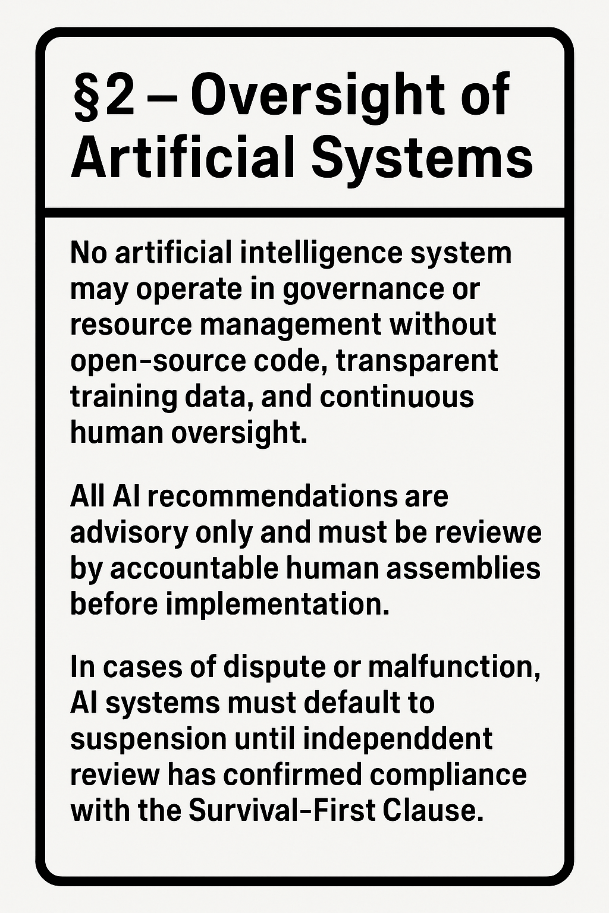
Artificial intelligence will inevitably become a part of this pillar—only if it remains neutral, open-source, and non-exploitable. AI must not be politicised or controlled by corporations. Instead, it should assist humanity, utilising the global knowledge archive to provide clear, verifiable insights. Currently, AI is a tool surrounded by hype: some people tremble in fear at the idea of machines taking over, while others use it daily as if it were no different from a calculator. The reality is somewhere in between. AI can be dangerous if it is captured, and it can be transformative if it is liberated.
When built correctly, AI could become the most powerful tool humanity has ever possessed: an oracle of knowledge, not in a mystical sense, but in a practical one. A system capable of connecting data points we would never be able to see ourselves, at speeds no human can rival. Used wisely, it could assist in building roads, restoring ecosystems, planning healthcare systems, and even resolving disputes—always as an aid, never as a master.
To achieve this, several boundaries are non-negotiable:
Neutrality: AI must be kept open-source, non-proprietary, and non-politicised. If corporations or governments control their training data, outputs, or algorithms, it becomes a weapon of influence, not a servant of knowledge.
Transparency: The data it draws from must be public and reviewable. The methods it uses must be visible and correctable. No “black box” decisions are acceptable in governance.
Advisory Role: AI can flag inconsistencies, model scenarios, simulate outcomes, and highlight risks. It can even propose projects based on emerging needs detected in the global registry. But it does not rule. Its role is to recommend, not to command.


Human Oversight: Every AI recommendation must be evaluated by humans at the local or interlocal level. For example, if the AI proposes a highway route, representatives from all affected communities must still weigh in, debate, and make a decision. AI provides clarity; people offer legitimacy.
AI will not eliminate opinion or compromise, and it should not. It exists to strengthen human decision-making, not replace it. Where humans bring context, values, and lived experience, AI brings speed, scale, and memory. Together, they create something neither could achieve on their own.
Education as a Right
Education must be free, neutral, and lifelong—not just in childhood but throughout a person’s life. Informed citizens make informed choices, and governance without rulers depends on that. Schools, libraries, and digital platforms must exist as commons, never as profit centres.
This also means protecting the right to think differently. Education is not indoctrination. It is equipping people with tools: literacy, numeracy, critical thinking, ecological awareness, digital literacy, and civic participation.
Education is not about what to think, but how to think. Let's get past the current cognitive level of public discourse, which is numbing at best.
Evolving with Time
Knowledge is never finished. Laws, environmental protections, and governance models must evolve with discoveries and changing conditions. What matters is not freezing rules in stone, but keeping the system flexible enough to adapt without breaking.
This pillar guarantees that no decision, law, or institution can stand still. It forces humility into governance by demanding evidence, transparency, and constant revision. It makes exploitation harder, superstition weaker, and freedom stronger.
Without free knowledge and education, the other pillars become fragile monuments. With it, they become a living, evolving structure.
(for engineers, policy makers, auditors)
• Require the survival-first clause in any system spec, contract, or charter.
• Make the clause verifiable: include measurable survival-oriented KPIs (food security, water access, ecosystem indicators, public health metrics).
• Design fail-safes: systems must default to conservative safety behaviours if uncertainty about survival risk exists.
• Ensure transparency: all models, objectives, and reward functions must be auditable.
• Human oversight: no irreversible action that materially risks life or ecosystems without human collective review and approval.
• Open governance: independent, multidisciplinary oversight panels (ecologists, physicians, ethicists, community reps) with the power to pause systems.
• No single-owner locks: the system’s objective and audit logs must be publicly recorded in the global registry.